by laura warde | Mar 25, 2024 | 2024 News, Blogs, News
Last week, Lexel and HPE Aruba teamed up to host an event to introduce a ‘game-changing’ approach to network security and connectivity. The event was set up to facilitate a discussion about how New Zealand businesses navigate the complexities of modern technology landscapes and was attended by Lexel customers in industries ranging from a global seafood company to broadcasting, secondary and tertiary education and support services.

Network Security with Aruba SASE
The shift from data-centre-centric to cloud-based applications has changed the way we work in recent years, making traditional security measures increasingly insufficient. The event allowed attendees to discuss the transition, emphasising the need for a more adaptable, secure, and efficient networking model.
Our key speakers, Jason Chai – Solutions Architect at Lexel and Andrew Fox – NZ Country Manager for Aruba, illustrated how SASE simplifies network management, enhances user experience, and scales efficiently with business needs. A unified security posture and reduced complexity mark the start of a new era in network security and performance optimisation. Both speakers brought invaluable perspectives on the necessity of embracing SASE in today’s digital and cloud-centric world. Their insights highlighted not only the technological advantages but also the strategic benefits of SASE for businesses.
“Being a small number of attendees gave good opportunity to talk with the Lexel
and Aruba people.”
Attendee from the Secondary Education sector
Find out what we discussed
Find out more by downloading the slide deck from the event below, and contact us here to discuss how you can get started on your journey to improve app performance, streamline management, and reduce your hardware footprint:
by laura warde | Mar 6, 2024 | 2024 News, Blogs, News
In the ever-evolving landscape of enterprise technology, SAP continues to be a driving force, transforming businesses and enhancing operational efficiency.
The demand for skilled SAP specialists is reaching new heights. Recognising this surge in demand, Lexel Resourcing now has a dedicated SAP Talent Bank. (If you’re an SAP Specialist and would like to join this movement, sign up here.)
Here we will discuss the reasons behind the escalating need for SAP experts and how choosing to align yourself with our SAP Talent Bank will be beneficial, whether you are a business on the lookout for SAP Talent, or SAP professional searching new opportunities.
In recent years, SAP has become the backbone of many businesses, offering a comprehensive suite of solutions that span various functions, from finance and HR to supply chain and customer relationship management. As organisations increasingly adopt SAP technologies to streamline their processes and stay ahead of the competition, the demand for skilled SAP specialists is skyrocketing.
Although several factors contribute to the heating up of the SAP talent market, one main reason stands out:
The deadline for migration to S4HANA is looming!
The migration deadline for organisations to transition to SAP S/4HANA is December 2027. From this date, SAP will discontinue mainstream maintenance and support for older SAP systems (although recently it has been announced that some cover will be available until 2029, at an additional cost on top of the already high structure). In reality, this means no bug fixes and security patches which increases risk and exposure to potential cyber threats, in addition to missing out on the additional features and functionality that come with the updated version.
Numerous benefits offered by S/4HANA when compared to its predecessors:
- S/4HANA offers advanced in-memory computing capabilities for real-time data processing and analytics.
- A more seamless integration of various modules such as finance, procurement, sales and warehousing. This enables better decision-making, enhancing efficiency and boosting overall productivity.
- Improved employee engagement due to modernised Fiori based UX.
- Increased total productivity as a result of runtime reduction of ERP reports on HANA database.
- S4HANA also harnesses the power of AI, machine learning and the IoT (Internet of Things)
Here’s the however…
Migrating to S/4HANA is a complex undertaking that demands meticulous planning, potential adjustments to existing processes and extensive testing!
Where we come in
As you embark on the journey to upgrade your systems, a critical decision looms: should you entrust the process to external consulting giants, or should you opt for more of an in-house talent pool of contractors and permanent or fixed-term IT resources.
Cost Savings. One of the most compelling reasons to opt for in-house talent is the potential for significant cost savings. By relying on permanent or fixed-term staff supplemented by contractors as needed, you can tailor your teams to project-specific needs, paying for expertise only when required. This flexible staffing model allows for a more cost-effective approach without sacrificing quality.
Control Over the Project. Maintaining control over the upgrade process is crucial for ensuring that it aligns with your company’s strategic objectives. In-house teams offer greater control and flexibility in decision-making, allowing organisations to adapt to evolving requirements and changes in real time.
Retention of IP. Once those high-paid external consultants exit the building, most of the IP they bring exits too. Using a blend of full-time employees (FTEs) and contract resources ensures the retention of IP within your business. Specialist contract resources can offer knowledge transfer and documentation as part of their deliverables remit.
Loyalty and Company Alignment. Longer-term contractors and FTE resources (engaged directly) are far more likely to have a vested interest in the success of a project than those consultants who work for large external consulting firms.
This loyalty translates into a commitment to delivering high-quality results and a willingness to go the extra mile to ensure the success of the SAP upgrade.
Lexel Resourcing’s SAP Talent Bank
In response to this escalating demand for SAP specialists, the SAP Talent Bank is now connecting top-tier SAP professionals with New Zealand organisations seeking their expertise.
Businesses leveraging the SAP Talent Bank gain access to a pool of highly skilled and pre-vetted SAP specialists at a reasonable cost. Quickly and efficiently find the right talent to meet specific needs.
The Talent Bank houses SAP specialists across the complete SAP environment, from planning and initiation through delivery, implementation, and testing, to optimisation and post-implementation. These resources are based in various parts of New Zealand and can be supplemented by off-shore SAP squads where necessary, enabling our clients to scale up or down at speed and further reducing costs.
Contact us to discuss how aligning with Lexel Resourcing’s SAP Talent Bank is a smart strategic move.
by laura warde | Jan 15, 2024 | 2023 News, Blogs, News

Adopting Sustainable IT Operations – Is it Worth It?
Embracing sustainability is no longer a choice, it’s a necessity. In today’s environmentally conscious New Zealand, consumers and customers are demanding companies adopt green practices more than ever before. By integrating sustainable strategies into the design, manufacturing, operation, and disposal of IT products, companies in the IT industry can not only satisfy their customers, but also create a better future. However, is this transition worth the investment?
Making the switch to eco-friendly tech isn’t a walk in the park. In this article, we will explore the challenges of going green, uncover the many benefits you can enjoy from adopting a sustainable business model and discuss how Lexel’s partnership with HP, a leading sustainable technology company, can help with your transition.
The Green Investment
Embracing sustainability can come with a higher price tag. To go-green, companies must invest in research and development, education and training, and supply-chain changes. However, when companies make these green investments, they open the door to a world of long-term benefits. These include reducing operating costs, capitalising on regulatory incentives and enhancing their brand image. Plus, it’s a surefire way to win over customers and build their loyalty, ultimately making sustainability a smart business move that balances environmental responsibility with economic gains.
Are you Equipped?
Many companies find they are not sufficiently equipped to successfully migrate to sustainable IT operations. To bridge this gap, companies can turn to external resources and partner with organisations who are experienced in the field of green IT. Rather than struggling to keep up with the constantly evolving tech landscape or hiring in-house experts, Lexel offers a wide array of ICT managed services, covering everything from endpoint devices to printing solutions. We also offer a suite of HP products designed with a commitment to preserving the Earth’s natural resources in mind.
Embrace sustainability today
Regulation Barriers
Navigating the complex world of environmental regulations and compliance standards can be like solving a riddle. These rules can vary significantly from place to place and may evolve over time. By partnering with ICT managed services like Lexel, you’ll find a winning formula. Lexel consistently delivers quality and innovation, ensuring your IT systems run smoothly, putting your business at the forefront of the competition. Through regular monitoring, maintenance, and top-notch security management of your endpoints, you’ll maximise operational efficiency while minimising risks.
Legacy Systems
Picture legacy IT assets as the wise elders of the tech world—these are the seasoned desktops, loyal laptops, and timeless software. Handling them often leaves IT departments scratching their heads. Why? Because they weren’t designed with modern security or sustainability in mind. The exciting part comes when you decide to give them a makeover. These systems have hidden potential. Upgrading them not only enhances their security but also injects fresh life into these trusted systems. With some care and attention, these classic systems can be optimised for sustainability, reducing their carbon footprint and energy consumption.
Balancing Sustainability and Security
Striking a balance between security and sustainability can be a juggling act, as certain security practices can inadvertently impact our environment. Take encryption, for instance, a cornerstone of cybersecurity, shielding sensitive data like financial records, personal information, and trade secrets from cyber threats. Yet, the energy consumption tied to encryption can significantly swell a company’s carbon footprint, especially for those managing vast data loads or relying heavily on cloud-based services. In response to this challenge, HP provides a range of eco-friendly products designed for energy efficiency and durability so they can stay in use for as long as possible, while Lexel provide convenient, service-based solutions aimed at delivering increased value to customers while minimising environmental impact.
Keeping Up to Date
The ever-evolving landscape of security threats and sustainable technology solutions presents a dynamic challenge for companies aiming to adapt and stay informed. In the realm of cybersecurity, threats are becoming increasingly sophisticated, with attackers continually devising new tactics to outsmart security measures. Staying ahead of the game requires a commitment to ongoing training, proactive security measures like threat hunting, and regular system updates. Keeping pace with these advances demands staying well-informed and adaptable. The Lexel team is your trusted partner on this journey, with a team of experts ready to keep you informed and guide your organisation to the forefront of this landscape.
Supply Gap
Sourcing eco-friendly IT equipment and solutions can pose a significant challenge. The scarcity of sustainable tech options often makes life hard for businesses aiming to blend security and eco-friendliness. Across New Zealand, many companies are putting sustainability at the forefront of their operations. However, they often struggle to find technology solutions that match their unique needs.
But there’s no need to worry when you have a trusted technology partner like Lexel by your side. We cover your tech needs, from data centre enhancements to eco-friendly IT products, including our range of HP endpoints and printing solutions. Instead of keeping up with evolving technology or hiring in-house experts, Lexel Systems offers ICT managed services that tap into decades of expertise, reducing risk and maximising service levels. Together, we pave the way to a greener, more sustainable future.
Adopting Sustainable IT Operations with Lexel and HP
Embracing sustainability isn’t just a choice; it’s a pathway to a brighter, greener, and more responsible future for businesses and our planet. Lexel, as your trusted technology partner, is fully committed to this journey.

In our drive towards sustainability, we have teamed with HP, a company that shares our values and places sustainable impact at the heart of their business strategy. HP has taken remarkable steps to advance sustainability, including their HP Device Recovery Service, designed to extend the lifespan of used devices, initiatives to minimise waste, and the use of eco-friendly materials to create circular products. They’ve reduced single-use plastics in their packaging by 44% and have responsibly reused and recycled 389,000 tonnes of hardware.
In our pursuit of a sustainable future, we actively seek out and recommend products that are not only innovative but also environmentally friendly. By choosing Lexel you can gain access to HP’s IT devices designed to reduce waste, improve energy efficiency, and promote green energy sources. Take the HP Elite Dragonfly G2 Notebook PC, for example, which incorporates >80% recycled materials in its mechanical parts, including 5% ocean-bound plastic from bottles in the speaker enclosure.
Let’s discuss how Lexel, with its managed services and top-notch endpoint devices and printing solutions, can take your organisation’s sustainability efforts to new heights. Together, we can create a better, greener tomorrow.
Join the movement today
by laura warde | Dec 12, 2023 | 2023 News, Blogs, News
Modern technology has allowed businesses to make operations more convenient, profitable and innovative. However, with a new age of opportunity comes potential risk. Cyber security threats have become increasingly complex, making it easier for them to impact your business’ growth and success. It’s never been more important to safeguard your digital activity, and a cyber security assessment can help you do that.

According to CERT NZ, research suggests that despite our best efforts and intentions, it is easy to forget or delay online security actions, like updating antivirus or business software – and it’s not always due to apathy. Business owners and decision makers are often too busy with tasks related directly to their business’ revenue and growth, leaving cyber security to become a lower priority. This results in a lack of awareness and appreciation for the importance of cyber security and can even lead to a perception that being secure online requires too much effort and upkeep to be worthwhile.
4 reasons cyber security for businesses must be a priority
1. Cyber impacts have becoming increasingly costly
According to CERT NZ, the average cybercrime incidents reported per quarter is 2,191. There were 1,968 reports in the first quarter of 2023 alone, with $5.8m in direct financial loss. This was 66% higher than in 2022.
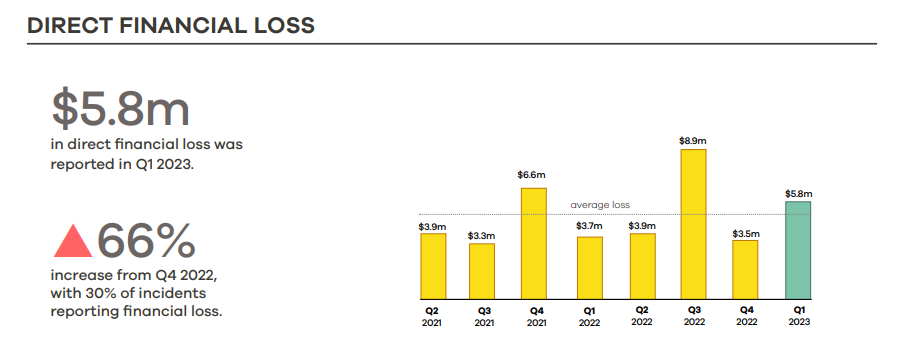
CERT NZ Cyber Security Insights
2. All data is important to protect
Some may consider certain data more important than others, but the fact remains that all data matters. It broadly defines every piece of digital information, whether it be financial details, personal information, or passwords. Attackers can take advantage of your security vulnerabilities, causing both immediate damage and long-term impacts that affect your future operations.
3. Attackers are upping their sophistication
Cybercrimes are becoming much more sinister. “Old school” scams (like Nigerian princes and chain emails) were once easy to spot, and business owners didn’t necessarily need to invest in their defence if they kept a keen eye. However, cyber-attacks are now being designed to fly under the radar and inflict serious damage.
Such attacks include:
- Phishing. Fraudulent emails, messages or websites masquerade as legitimate sources aiming to trick people into granting unauthorised access or revealing things like credit card details or passwords. They are the most used and most effective cyber-attack.
- Ransomware. Cybercriminals encrypt an organisation’s data, prohibiting access unless a ransom is paid.
- Malware and spyware. Malicious software programs that infiltrate systems and steal information via infected files, software downloads, or compromised websites.
- Social engineering attacks. Cyber criminals impersonate, pretext or manipulate emotions to encourage someone to divulge sensitive information or perform actions that compromise security.
4. It’s not just your business that will be impacted
Cybercriminals often aim to steal employee and customer data through your systems, and may even target your supply chain to gain unauthorised access. If there are weaknesses in third-party vendor or supplier systems, this will likely be successful, which ultimately impacts your partners.
Ways to improve your defence against cyber security threats
When you take proactive steps to enhance your cyber security, you have the chance to mitigate attacks. Here are some strategies to deploy.
A cyber security risk assessment offers a proactive and systematic way to assess your security measures, ensure regulation compliance, and identify vulnerabilities. It plays a critical role in your overall risk management plan, and is critical for upholding business continuity, protecting sensitive data, and maintaining customer trust.
Secure your network
Use a strong, unique password to protect your network. You should also consider deploying a firewall and encrypting your Wi-Fi network to prohibit unauthorised access.
Stay alert and aware
Stop and think before clicking on links or downloading attachments from unknown sources. These could be veiled attacks. Exercise caution and verify the legitimacy of any messages before sharing personal information or data.
Foster greater awareness
Stay informed and keep your team educated on the latest cybersecurity threats and best practices. Ensure everyone in your business knows about potential risks and how to identify suspicious activity.
Regularly update software and back up data
Updates often include security patches that address known vulnerabilities in your operating systems, applications, and antivirus software. So, if an update is available be sure to take action. You should also regularly back up your data so you can recover more easily in the event of an incident.
Deploy strong passwords and authentication Enable two-factor authentication (2FA) whenever possible and use strong, unique passwords for each online account. This adds an extra layer of security that could help keep you protected.
Mitigate cyber risks with a cyber security assessment from Lexel
Assessing your security is important and extremely valuable, but it can be hard to do it accurately without the right support. This is where Lexel can help.
With your Lexel cyber security assessment, we can help you determine how secure your business is. This includes an initial review of your current firewalls, security software and regulatory compliance, along with recommendations on how to address issues and capitalise on strengths discovered throughout the assessment.
Once this is complete, we can provide expert cyber security solutions tailored to your business. That way, you’ll have all the resources and information required to operate with confidence in the digital world.
Book a call with our team below to register for your Cyber Security Assessment.
by laura warde | Sep 19, 2023 | 2023 News, Blogs, News

Any fundamental change to the way organisations work will pose security challenges. Over the past few years, enterprises have rapidly evolved to champion hybrid working models, and to facilitate this, more critical workloads have been moved to cloud and edge deployments.
Traditional ways of enabling and securing these environments are ineffective. VPNs offer powerful 256-bit AES encryption, but that encryption process comes at the expense of performance, and VPNs only require a user ID and password to create a difficult-to-monitor connection to the network.
Meanwhile, many cloud and edge environments are structured around proxy servers, as they are an effective way to route cloud traffic. However, proxy servers pose several risks, including:
- Performance and Scalability: Each request needs to pass through the proxy server which can result in slower page loading times especially when it decrypts messages. Once the proxy server shows signs of limiting network speed, it must be upgraded.
- Security Risks: Proxy servers can introduce security vulnerabilities if not properly configured or secured. Cyber criminals that gain access to proxy servers can use them to intercept and manipulate traffic, potentially exposing sensitive information or injecting malicious code.
- Reliability and Availability: Proxy servers can become single points of failure within a network architecture. If a proxy server experiences an outage or becomes inaccessible, it can disrupt activities.
- Trustworthiness of Proxy Providers: A proxy servers may log user data, sell information to third parties, or engage in malicious activities.
SASE is the solution to these inherent weaknesses. Its deep security features, including Secure Web Gateway (SWG), Cloud Access Security Broker (CASB), Data Loss Prevention (DLP), and Zero Trust Network Access (ZTNA), provide a deeper level of protection and better performance in cloud-native environments.
SASE fully realises the potential of the cloud
For most organisations that are looking to transformation and the cloud, one of the key priorities is breaking down networking and security team siloes to achieve superior operational and cybersecurity effectiveness. A cloud-based SASE architecture makes true technology convergence possible. Key benefits that can be realised through SASE include:
Direct Cloud Access: SASE provides direct and secure access to cloud resources, eliminating traffic backhauling through on-premises datacentres. This direct access can deliver faster application response times and an improved user experience, especially for cloud-based applications.
Optimised Routing: SASE solutions can use intelligent routing algorithms to optimise traffic flow, ensuring that data takes the most efficient path to reach its destination. This can lead to improved performance for both cloud and on-premise resources.
Application Acceleration: SASE platforms can be leveraged for application acceleration, and through that can further enhance performance, especially for resource-intensive applications.
Micro-Segmentation: SASE’s micro-segmentation capabilities, such as Software-Defined Perimeter (SDP), boost security by limiting access to specific resources based on user identity and authorisation. By reducing the attack surface and focusing access only on what is necessary, SASE can improve network performance and security simultaneously.
Zero Trust Security: Finally, the ZTNA approach inherent to SASE is the definitive approach to security in modern IT environments. It ensures that users and devices are authenticated and authorised before accessing specific resources. This reduces the risk of unauthorised access as well as the potential network congestion that could occur with traditional VPNs.
One final, hugely relevant benefit of SASE for security
There’s a lot being said about the security implications of AI applications like ChatGPT, as data can “leak” into the scraping mechanisms of these platforms, and from there disseminate it by accident, without anyone necessarily knowing. For organisations handling sensitive data in highly regulated environments, this is a particular concern, as data leaks can come from otherwise benign and well-meaning sources.
SASE-based access control, backed by zero-trust security and DLP capabilities are proving to be one of the most effective responses to this challenge. It will prevent unauthorised users (including AI applications) from accessing the data in the first place, and then, the DLP will trigger even if an authorised user attempts to exfiltrate the data into an AI application.
SASE is the foundation of a well-designed, dynamic and cloud-powered organisation. With it in place, it’s possible to capitalise on the full scale of possibilities in the cloud with the confidence that there is uncompromising security in place, but in a way that doesn’t undermine productivity gains.
Learn more about the compelling benefits of SASE for both security and performance – and how you can implement it into your cloud environment today – with Aruba and Lexel. Contact us now.